CALL US NOW :
(716) 772-7500
EMAIL ADDRESS :
info@drkaplansky.com
LOCATION ADDRESS :
8038 Rochester Rd. Gasport NY
(716) 772-7500
info@drkaplansky.com
8038 Rochester Rd. Gasport NY
Thirty questions patients ask Dr. Igor Kaplansky most often — covering TeethNow zirconia full-arch restoration, zygomatic implants for severe bone loss, CBCT-guided planning, recovery, cost ranges, CareCredit financing, and what makes a Diplomate ABOI/ID and ZAGA Center Certified surgeon different from a chain provider. Call (716) 772-7500 to schedule a consultation.
TeethNow is a comprehensive full-mouth restoration solution designed for patients seeking a streamlined process. You’ll receive a temporary set of healing teeth the day after your implant procedure, followed by your permanent teeth within 4-5 months, providing a natural, long-lasting smile.
All-on-4 is a concept for placing four implants to support a fixed full-arch prosthetic. TeethNow is our complete, in-house protocol that builds on that concept with a permanent zirconia prosthetic at 4–5 months — not a long-term acrylic or hybrid denture. The result is more durable, more aesthetic, and less prone to wear than typical All-on-4 finishes.
Zygomatic implants are longer titanium implants that anchor in the zygoma (cheekbone) instead of the upper jaw. They are designed for patients with severe maxillary bone loss who do not have enough bone for traditional implants. Dentistry by Dr. Kaplansky is one of 11 ZAGA-certified zygomatic centers in the United States, and Dr. Kaplansky co-authored the clinical textbook on this technique.
Zygomatic implants allow patients with severe upper-jaw bone loss to receive a fixed full-arch prosthetic — often the same day — without bone grafting and without a prolonged staged surgery. Compared with traditional implants plus grafting, zygomatics shorten total treatment time, reduce surgical visits, and restore chewing function immediately.
No, TeethNow requires adequate bone for standard implants and cannot be combined with zygomatic implants. However, Dr. Kaplansky offers other implant solutions tailored for patients with significant bone loss.
Most patients who need tooth replacement are candidates for dental implants. Dr. Kaplansky will evaluate your bone structure and dental health to recommend the best implant solution, whether it’s TeethNow, zygomatic implants, or another option tailored to your needs.
Very few patients are truly disqualified. Uncontrolled diabetes, active chemotherapy, certain bisphosphonate medications, and heavy smoking can complicate healing, but most of these factors are manageable. Severe bone loss is no longer a disqualifier thanks to zygomatic implants. Dr. Kaplansky regularly treats patients who have been told elsewhere they are not candidates.
Yes, smokers can receive dental implants, but smoking does increase the risk of implant failure and slows healing. We recommend cutting back or stopping for the duration of the healing period — at least 4–6 weeks before and after surgery. Long-term smoking is a risk factor for peri-implantitis, similar to its effect on natural teeth.
There is no upper age limit — Dr. Kaplansky has successfully treated patients in their 90s. Implants require skeletal maturity, so we generally wait until late teens or early 20s for the lower limit. Overall health and bone quality matter more than chronological age. Many of our most successful full-arch cases are patients between 55 and 80.
If you’re considering dental implants and want to learn more before your appointment, we recommend visiting the AAID consumer website. It’s a trusted resource backed by the American Academy of Implant Dentistry and includes expert-reviewed FAQs, videos, and patient testimonials. This site helps you feel more confident and informed about your treatment options.
We offer flexible third-party financing options, such as CareCredit, including interest-free promotional plans, to make high-quality dental care accessible. Our team will help you choose a plan that fits your budget so you can focus on your new smile without financial stress.
Implant cost depends on case complexity, the number of implants needed, and the prosthetic chosen. We use a transparent four-tier structure: single-tooth implant, multiple-tooth implant, TeethNow full-arch zirconia, and zygomatic implants. After a CBCT scan and consultation with Dr. Kaplansky, you receive a written treatment plan with a specific price — no surprises later.
Most dental plans cover at least a portion of the implant restoration (crown, bridge, or hybrid), and many cover part of the surgical placement. Our team verifies your benefits before treatment and submits claims on your behalf. For costs not covered by insurance, we offer CareCredit and Lending Club financing, including interest-free plans.
Most patients use a combination of insurance benefits, HSA/FSA funds, and a financing plan. CareCredit and Lending Club provide third-party financing with terms from 6 to 60 months, including interest-free options for qualified applicants. We can model a monthly payment against your treatment plan during your consultation.
With TeethNow, you’ll receive a temporary set of healing teeth the day after surgery. Your custom-designed permanent teeth will be placed once the implants have fully healed, usually within 4-5 months.
A single-tooth implant typically takes 4–6 months from placement to final crown. Full-arch TeethNow patients receive their fixed healing teeth the day after surgery and their permanent zirconia prosthetic at 4–5 months. Zygomatic implants are placed and loaded with a fixed temporary prosthetic on the same day. Each case begins with a CBCT scan and personalized timeline from Dr. Kaplansky.
Not always. Many patients have adequate bone for immediate placement. When bone volume is insufficient, a graft (autograft, allograft, xenograft, or synthetic) can rebuild the site before implants are placed. For severe upper-jaw bone loss, zygomatic implants anchor in the cheekbone and often eliminate the need for grafting entirely.
Often yes. In many cases, an implant can be placed at the same appointment as the extraction (immediate placement), preserving the bone socket and saving months of treatment time. In other cases, we allow 8–12 weeks for the site to heal and stabilize before placing the implant. Dr. Kaplansky decides based on the CBCT scan and tissue condition.
If you’ve been told you don’t have enough bone for traditional implants, zygomatic implants might be an option. These specialized implants anchor into the cheekbone instead of the jawbone, providing a secure foundation without the need for bone grafting.
Implant surgery is performed under local anesthesia and IV or oral sedation, so you do not feel pain during the procedure. Most patients report that recovery is more comfortable than a routine tooth extraction — typically managed with over-the-counter ibuprofen and acetaminophen for 2–3 days. Significant or prolonged pain is uncommon and should be reported.
Mild swelling and tenderness are normal for 2–4 days. Most patients return to office work within 1–2 days. With TeethNow, you leave the appointment with a fixed set of healing teeth, so you are never without teeth. Full osseointegration — the implant fusing with bone — takes 3–6 months before final prosthetics are placed.
Caring for your implants is similar to caring for natural teeth. Brush and floss daily, maintain regular dental check-ups, and avoid habits like teeth grinding to ensure the longevity of your implants.
With proper care, dental implants are designed to last a lifetime. The durability of zirconia implants and precise placement by Dr. Kaplansky provide a reliable, long-term solution for tooth replacement.
Dental implants outperform conventional dentures on every long-term metric: chewing efficiency, speech, bone preservation, and stability. Dentures rest on the gums and accelerate jawbone shrinkage; implants transmit bite force into the bone and preserve it. The trade-offs are upfront cost and surgery. For patients who want a permanent solution, implants are typically the better long-term investment.
A traditional bridge requires grinding down the two healthy teeth next to the gap to support a three-unit prosthetic. A single implant replaces the missing tooth without involving the neighbors and preserves the bone underneath. Implants typically last decades longer than bridges. The bridge is faster and lower cost upfront; the implant is the better long-term choice in most cases.
Zirconia is a tooth-colored ceramic used for both implant crowns and full-arch prosthetics. It is biocompatible, resists plaque, and looks more natural at the gumline than metal. Our TeethNow protocol uses a permanent zirconia full-arch prosthetic for maximum durability and aesthetics. Zirconia is a strong option for metal-sensitive patients and anyone prioritizing natural appearance.
Dental implants have one of the highest success rates in modern surgery — over 95% at 10 years when placed by experienced surgeons. The titanium and zirconia materials used are biocompatible and have decades of clinical history. Risks (infection, nerve injury, sinus complications) are uncommon and minimized by CBCT-guided planning and proper case selection.
Implant failure is rare but possible — typically caused by infection (peri-implantitis), inadequate bone healing, or excessive bite force. Warning signs include pain or pressure that does not improve, looseness, gum recession around the implant, or visible threads. If you notice any of these symptoms, contact our office — early intervention almost always saves the implant.
When a tooth is lost, the surrounding jawbone begins to resorb because it no longer receives chewing force. A dental implant, fused into the bone, transmits bite force just like a natural tooth root — stimulating the bone and preserving its volume and shape. This is why patients with implants maintain their facial structure better than patients with dentures or empty sockets.
The longer you wait after a tooth is lost, the more the underlying bone shrinks. This can complicate later implant placement — sometimes requiring grafting or zygomatic implants instead of standard implants. Delay also accelerates shifting of adjacent teeth and changes in your bite. If you are considering implants, an early consultation locks in your options before the case becomes more complex.
Every case begins with a CBCT scan and a treatment plan built specifically for you — never a stock case adapted to fit a surgery schedule.
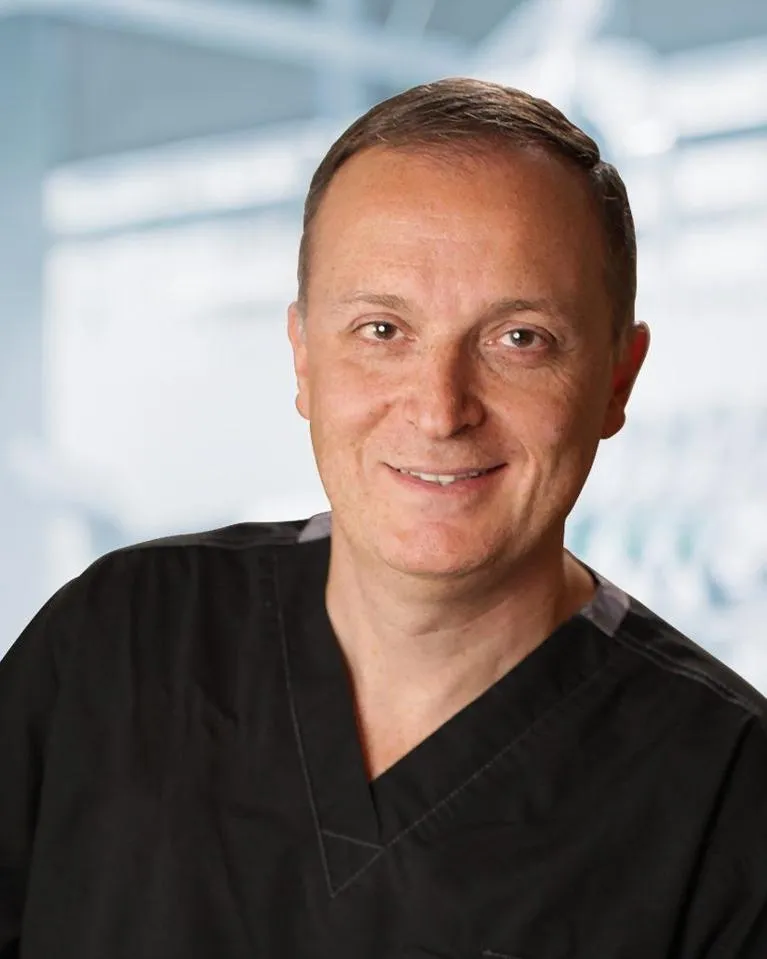
DDS · Diplomate ABOI/ID · Fellow AAID/FICOI/FAGD · ZAGA Center Certified
Dr. Igor Kaplansky holds Diplomate-level board certification in oral implantology — a credential earned by fewer than 600 dentists in the United States — and co-authored the clinical textbook on zygomatic implant technique.
Credentials: